Oracle Supply Chain Planning

助您在云端管理端到端的供应链计划解决方案,加速取得更显著的成果。您可以轻松结合需求洞察、供应约束和利益相关方意见,应用内置机器学习改善盈利能力,同时加速提供卓越客户服务。

了解我们的客户如何利用 Oracle Supply Chain Planning 解决方案取得更显著的成果 (1:35)

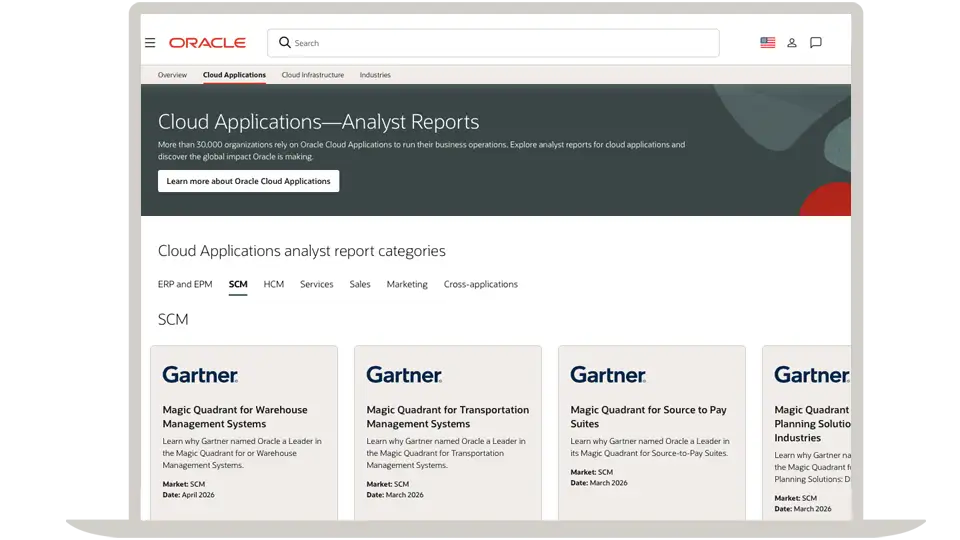
Gartner® 供应链计划解决方案离散制造行业魔力象限 报告

Oracle Supply Chain Planning 提供内置 AI、机器学习和预测性洞察,可帮助企业改善需求预测、自动补货并规划好整个供应链。了解 Gartner® 为何在 2026 年供应链计划解决方案离散制造行业魔力象限™ 报告中将 Oracle 评为“领导者”。*

Oracle Fusion Cloud Supply Chain Planning

了解 Oracle 供应链计划软件如何在一个统一平台上满足各类企业的独特需求,包括高科技和制造企业、项目导向的组织、批发商和分销商、医疗保健服务提供商以及基于服务的供应链。

感知、预测和调整需求,改善业务成果

新一代需求管理解决方案,融合了补货计划、细分功能、新产品发布以及面向计划人员的机器学习特性。

感知需求,提高可见性

将各种来源的定性和定量信号转化为业务洞察。

按细分进行需求分析

动态地将品项、位置以及行为相似的客户分组到同一个细分中,共享同一个需求档案。

预测需求,管理变化

利用机器学习生成更加准确的预测,同时衡量并跟踪预测错误的根本原因。

评估需求变化的影响

分析季节性因素、促销事件、产品属性和领先指数的原因和结果,然后有针对性地调整库存。

调整需求,实现业务目标

模拟预测场景,与利益相关者开展协作,管理新产品发布,从而改善业务绩效。

基于制造策略构建可靠的需求计划

跟踪变更、监视异常并与 S&OP 及供应计划保持同步,确保流程正常运行。


需求驱动的补货

轻松高效地创建补货计划,同时利用基于需求细分的定制化库存策略和消耗规则,提高履行准确性。

制定以客户为中心的需求计划

整合需求驱动的消耗、库存和履行,满足客户的特定需求。

预测消耗趋势,优化服务水平

预测需求,预测季节性因素、趋势以及基于事件的变化,确保供应处于库存阈值之内。

基于需求细分创建个性化库存策略

基于商品和位置组的行为自动将补货参数分配给商品和位置组,以减少缺货情况。

模拟并解决补货问题

图形化地模拟和调整各个品项和位置的补货策略,改善绩效。

自动化持续补货

计算补货需求,在消耗发生时自动下达计划订单。

做出更有效的补货购买决策

整合订单,充分提高分段价格并节省运输成本,同时保持服务级别。


优化服务资源和成本

识别并执行合适的供需计划。跨多层级位置进行品项规划,识别和解决重要的问题,并模拟潜在响应,优化客户服务和库存成本。

统一计划流程

平衡供需,优化服务库存和成本,针对多种物料和产能场景制定计划。

制定全面的供应链计划

制定全方位的计划,涵盖流程、离散、项目驱动、按订单配置和外包生产,以及直接交付和背对背履行。

监视供应问题并进行优先级排序

使用嵌入式分析查看 KPI 受到的影响,例如利润和周转,并导航至问题领域。

预测并主动响应中断

审核并与内部及外部利益相关者协同处理计划内供应订单变更。充分利用内置机器学习或与物联网系统的集成特性。


提高生产效率

通过日间生产排程充分利用瓶颈资源和可用组件;降低在制品库存、浪费和支出;以可视化方式呈现如何将工单操作分配至资源;通过拖放式操作模拟对问题或变更的响应措施,发布实时排程。

创建高质量、可执行的生产排程

基于实时资源可用性和 Oracle Cloud Fusion Manufacturing 中的工单,综合考虑新的物料、产能和日历制约因素来创建可行排程。

优化生产转换,尽可能减少停机时间

基于行业属性,通过有效排程提高转换效率,缩短闲置时间,进而提高吞吐量和资产利用率。

解决车间瓶颈问题

基于属性顺序进行工单排程,充分提高生产线效率。通过替代资源消除瓶颈。

模拟排程变更的影响

在可视化甘特图中轻松检查排程,分析生产问题。如有需要,通过拖放式操作进行调节和调度编辑。运行快速内联模拟,通过“假设”(What-if) 场景建模解决问题。

尽可能降低计划外停机的影响

动态运行和调整生产排程,灵活应对计划外机器停机、劳动力短缺、物料延迟和订单优先级变更。必要时发布修订后生产排程,由车间即时执行。

主动监视车间

快速评估工厂生产排程,通过交互式分析捕获转换时间、资源利用率以及延迟订单洞察。

了解有关使用 Oracle Cloud Manufacturing 执行生产排程的更多信息


智能管理未结订单

在供应或需求发生变化时,对未结订单进行优先级排序,从而减少交货延迟、提升销售额、实现利润目标。模拟多种履行备选方案,选择与业务目标相符的方案。

智能响应供需变化

利用可用供应来满足新订单需求,降低延迟,同时满足现有的承诺日期需求。

优先履行重要订单

使用灵活的业务规则对积压订单进行优先级排序,从而充分提高订单收入、利润并改善服务。

解决寻源和履行问题

对寻源、运输模式和运输约束进行“假设”(what-if) 变更建模,从而快速响应,找到合适的解决方案。

执行“假设”(what-if) 订单计划

模拟潜在订单将对剩余积压订单的排程和可用性产生怎样的影响。


通过持续计划统一企业运营

跨销售、营销、财务和供应链组织协同业务计划与运营。提高运营敏捷性,从而跨整个组织灵活编排变更,平衡供需,改善业务成果。

全企业协同一致

利用内置、集成式业务计划流程和协作工具促进利益相关者达成共识。

建立切实可行的整体计划

通过建模和对比备选的受约束计划场景来平衡整体供需。

实现业务目标

通过个性化、KPI 驱动的仪表盘获取洞察,从而为收入增长和成本管理权衡决策提供支持。

满怀信心地按照共识计划行动

快速汇总和分解需求与供应计划,从而优化利用率和投资决策。


打通计划、执行、财务与运营

通过物联网、人工智能和指导性分析将计划转化为执行,监视活动并检测意外事件;模拟和评估备选响应方案,巩固或改善业务目标。

降低决策延迟

充分利用实时、详细的计划和执行信息,更加快速、有效地应对不利趋势。

在一个平台上整合所有计划

在单一数据模型中无缝集成计划与执行,从而改善短期和长期战略计划。

提高整个企业的可见性

基于统一数据模型为所有参与者提供统一视图;基于高级分析进行业务成果预测,从而降低业务复杂性,赋能管理人员及时做出有效决策。


与贸易伙伴互动,减少供应链中断

与战略供应商和合同制造商有效开展供应协作,协商预测承诺,及时解决问题,避免对客户服务造成不利影响。

协作式订单预测

与供应商共享订单预测,审核变更,并将变更集成到供应链计划流程中。

编排供应商承诺

端到端管理供应商承诺磋商以及服务级别协议执行流程。

实现供应商管理的库存

支持供应商对存储在您仓库中的寄售物料和未寄售物料触发订单和确认装运。

与合同制造商协作

根据外包生产进度,自动更新合同制造工单的状态。

在线供应商访问

让供应商能通过供应商门户轻松、交互地融入协作和可见性流程。

跨多个供应商层级同步

捕获合同制造商和供应商的现货、现有订单和在途供应信息,从而改善供应计划。


主动响应供应链变化

在企业内部更加深入地洞悉上游供应状况,并与战略供应商和合同制造商有效协作;提前收到预期不一致的警报,并在供应计划中充分利用可用的供应商产能。

实时分析供应链活动

使用 Oracle Transactional Business Intelligence (OTBI) 分析和报告供应链的实时状态。

评估端到端供应链绩效

在 Oracle Fusion Analytics Warehouse 中以可视化方式呈现全球供应链的整体绩效。

使用 web 服务将可见性自动化

通过 REST 服务,以编程方式访问 Oracle Supply Chain Management Cloud 事务的实时状态。

使用机器学习预测供应链事件

对物联网供应链信号进行预测性分析,洞悉未来。

通过数字主线跟踪供应链活动

在基于区块链的数字分类账中捕获并可视化呈现供应链事务编排。


Product tour—Oracle Fusion Cloud Supply Chain Planning

Plan for the Future of Supply Chain Decision-Making

Modernizing Supply Chain Planning with Oracle

Today's supply chains are more global, complex, and volatile than ever. To increase revenue and reduce costs, you need future-ready supply chain planning that's fast, simple, and intelligent. Oracle Supply Chain Planning gives you better ways to anticipate demand, manage supply, and align stakeholder and trading partner actions with your objectives.

Create your strategic plans

Effective enterprises create integrated business plans to align strategic finance and operations. Oracle Fusion Cloud Sales and Operations Planning translates CFO revenue, margin, and cost objectives into corresponding global supply chain plans. Its aggregate planning capability identifies opportunities to evolve the product mix, sourcing, production, and distribution strategies to achieve profitability and growth targets.

Collaborate to gain alignment

Key stakeholders must contribute, collaborate, and come to consensus on goal-congruent, connected product, financial, sales, marketing, supply chain, and workforce plans. Best-practice planning stages and workflows guide users through tasks, allowing them to track milestones and overall progress.

Get intelligent insights from generative AI

Embedded AI agents help planners save time and gain confidence in their decisions. They provide enterprise-specific planning process advice, as well as analysis of new item demand, supply disruptions, lead time deviations, stale parameter settings, and configuration errors.

Integrate business planning, tactical planning, and execution

Oracle Supply Chain Planning continuously bridges the gap between strategic plans and sales and operations execution (S&OE). You can deploy integrated business planning (IBP) consensus forecasts as the baseline for more granular tactical forecasts in Oracle Fusion Cloud Demand Management, as well as for tactical supply plans in Oracle Fusion Cloud Supply Planning.

Sense, predict, and shape demand

Oracle Demand Management can combine enterprise demand, such as orders and shipments, with weather, economic, social, and other external data signals to enhance demand sensing. It also decomposes demand into baseline, trend, seasonal, and event-based components so you can understand what's driving the forecast.

Leverage built-in machine learning to improve forecast accuracy

Oracle Demand Management uses Bayesian blending and other machine learning techniques to predict demand more accurately. It adapts to handle short-lifecycle, intermittent, seasonal, promotional, and configured items. It also automatically detects outliers, fills data gaps, and fine-tunes targeted parameters to minimize forecast error.

Automate demand-driven replenishment

Oracle Demand Management can automate demand-driven, time-phased replenishment processes across a multi-echelon network of stores, depots, and other regularly stocked locations. It also replenishes periodic automated replenishment (PAR) locations in clinical settings. You can quickly resolve stockouts and other inventory exceptions interactively through graphical simulation. You can also consolidate purchases to achieve price breaks and reduce logistics costs.

Plan your supply chain by segment

Demand patterns and inventory objectives can vary widely among replenishment locations. Using Oracle's replenishment planning features, you can divide your business into dynamic, rule-based segments with independent policies. Flexible segment criteria can include cost, volume, volatility, and many other attributes.

Plan supply to maximize service at the lowest risk and cost

Oracle Supply Planning determines the inventory, capacity, and material supply required to meet demand, including drop shipments, back-to-back orders, and contract-manufactured items. It also highlights exceptions such as demand compression, material shortages, and resource overloads that can put demand at risk. As you choose from proposed expediting actions, capacity increases, and other interventions, you can see their financial and customer service impact.

Work around material, resource, and capacity constraints

Hybrid constraint-based planning automatically evaluates ways to prevent constraint violations while recommending ways to fulfill demands on time. The solution evaluates options such as building ahead of time, alternate resources, substitutes, and alternate suppliers to help you overcome material and capacity constraints. You can set inviolable capacity constraints for some resources and suppliers while allowing others to be overloaded if there’s no alternative.

Tailor planning to industry requirements

Planning processes and objectives differ dramatically by industry. Whether your focus is on wholesale distribution, mixed-mode manufacturing, engineer-to-order, project-based, or clinical supply chains, Oracle Supply Chain Planning adjusts to meet your needs. Attribute-based planning matches demand with supplies based on the minimum grade, country of origin, project, and other flexible criteria.

Schedule and monitor production activities

Oracle Supply Planning schedules production during the day to maximize use of bottleneck resources, increase factory throughput, and improve delivery performance. It proactively adjusts the sequence and timing of jobs in the factory in sync with real-time shop floor events, reducing changeovers, inventory, waste, and expedites.

Strategically manage your order backlog

Oracle Supply Planning's backlog management features help you prioritize and reschedule your open sales orders when items are on allocation or supply availability changes. Simulate alternate scenarios and change sourcing, expedite transportation, or split lines to reduce delivery delays, increase sales, or preserve margins.

Engage trading partners to reduce supply chain disruptions

In today's globally distributed supply chains, it's essential to synchronize your plans with customers, contract manufacturers, and suppliers. Oracle Fusion Cloud Supply Chain Collaboration provides visibility into downstream demand and upstream supply commitments, alerting you to any mismatches. With advance warning, you can collaborate across multiple supply chain tiers to facilitate alignment from end to end.

Unify planning and execution from end to end

Oracle Supply Chain Planning is a critical component of your overall supply chain management ecosystem. Planning insights and machine learning models drive manufacturing, inventory, transportation, and procurement actions so you can respond appropriately to issues across your supply chain network.

Supply Chain Planning 客户成功案例

Oracle Fusion Cloud Supply Chain Planning 软件助力全球各行各业的客户提高弹性,实现卓越运营。

Oracle Supply Chain Planning 资源

赶快行动


Supply Chain Planning 实况演示

立即预约观看 Oracle Supply Chain Planning 专家演示!


Oracle Supply Chain Planning 解决方案简介

阅读 Oracle Supply Chain Planning 软件解决方案简介。


联系 SCM 销售人员

联系 Oracle Supply Chain Planning 团队,了解更多信息。

* Gartner,Magic Quadrant for Supply Chain Planning Solutions: Discrete Industries,Joe Graham、Pia Orup Lund、Buse Aras、Julia von Massow、Eva Dawkins、Jan Snoeckx,2026 年 3 月 18 日。

此图形系 Gartner, Inc. 完整研究文档的一部分,应在整个文档中予以评估。您可向 Oracle 申请获取 Gartner 文档。Gartner 对其研究出版物中所描述的任何供应商、产品或服务不做任何推荐,也不建议技术用户仅选择排名最高或其它特指的供应商。Gartner 研究出版物包含 Gartner 研究机构的观点,不应被视为事实陈述。Gartner 关于此研究不作任何明示或暗示担保,包括任何特定用途的适销性或适用性。GARTNER 是一个注册商标和服务商标,MAGIC QUADRANT 是 Gartner, Inc. 和/或其附属公司在美国和国际的注册商标,此处的使用已获得授权。保留所有权利。

注:为免疑义,本网页所用以下术语专指以下含义:

  1. 除Oracle隐私政策外,本网站中提及的“Oracle”专指Oracle境外公司而非甲骨文中国。
  2. 相关Cloud或云术语均指代Oracle境外公司提供的云技术或其解决方案。